

Prof. Abdur-Rahman Abdullah Calls for Universities to Move from Scholarship to Societal Impact
The Vice-Chancellor of Minaret University, Ikirun, Prof. Abdur-Rahman Abdullah, has challenged universities to look beyond the traditional pursuit and transmission of knowledge and demonstrate their relevance through practical contributions to society.
He made the call on Thursday, October 1, 2026, while delivering the keynote address at the MKAN Academic Seminar 4.0, organised by the Majlis Khuddam-ul-Ahmadiyya Nigeria (MKAN). The seminar, themed “From Knowledge to Impact: Reimagining Academia for a Changing World,” brought together almost 100 participants across the country and beyond. Prof. Abdullah’s keynote address was titled “From Scholarship to Societal Impact: Redefining the Role of the University in the 21st Century.”
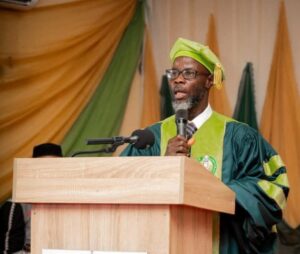
Speaking on the changing landscape of higher education, the Vice-Chancellor noted that universities today operate in an environment shaped by rapid technological advancement, globalisation, changing economic demands, demographic shifts and increasingly complex social challenges. He stressed that these developments require universities to rethink their traditional roles and find new ways of serving society.
According to the Vice-Chancellor, universities have historically been seen as custodians and transmitters of knowledge, but knowledge alone is no longer enough.
“Society is not asking the university, ‘What do you know?’ Society is asking, ‘What can you do with what you know, and whom does it serve?’” He described this as the fundamental shift that Minaret University seeks to embody.
The Vice-Chancellor called for a transition from what he described as the traditional “ivory tower” model of the university to an “engine room” that actively contributes to solving societal problems. He explained that academic research must increasingly translate into practical outcomes. Research on youth unemployment, for instance, should contribute to producing graduates capable not only of finding employment but also of creating it. Likewise, disciplines such as Data Science should be applied to real-world challenges, including agricultural logistics, cybersecurity and primary healthcare.
“Scholarship remains our foundation, but societal impact must be our evidence.”
The Vice-Chancellor identified three pillars that should define a relevant university in the 21st century. The first is “From Certificates to Competencies.” He explained that graduates must leave the university with more than academic certificates. They should possess practical skills, the ability to solve problems and the mindset to create opportunities and employment.
The second is “From Local Presence to Local Relevance.” The Vice-Chancellor noted that a university cannot be located in a community without being meaningfully connected to that community. He identified agriculture, small-scale trade, education and peacebuilding among areas where universities can develop solutions to local problems and subsequently scale them to national relevance.
The third is “From Moral Knowledge to Moral Character.” He emphasised that the purpose of education should extend beyond intellectual excellence. In an age of artificial intelligence, misinformation and growing ethical concerns, universities must also help shape individuals of integrity, discipline and service.
Highlighting Minaret University’s identity, the Vice-Chancellor described the institution as the first Ahmadiyya university globally, noting its emphasis on discipline, service and reverence for humanity. He also reaffirmed the University’s openness to people of all faiths while maintaining its commitment to honesty, integrity, service and respect for others.
The Vice-Chancellor called on academics, students and other stakeholders to reconsider how excellence in higher education is understood. He mentioned that the real measure of a university should not be limited to its buildings, publications or academic reputation, but should also include the depth of its roots in society and the practical value of its contributions.
He challenged stakeholders to build universities that students would be proud to graduate from, and society would be proud to be served by. He called for excellence not only in the library, but also in the marketplace, on the farm, in the boardroom and in the wider community.
The seminar also featured distinguished panellists, including Prof. Modinat Adejoke Adekoya-Iromini of the Federal University Oye-Ekiti, Dr Lukman Ayanniyi Sunmonu, an Associate Professor of Atmospheric Physics at Obafemi Awolowo University, Engr. Yusuf Adeyemi, a Solution Architect and Founder of CodeLearnersHub, and Amb. Popoola Ishaq Olamilekan, a Data Platforms and Cloud Technologies Specialist.
The event was chaired by Alh. Alatoye Folorunso Azeez, Amir of the Ahmadiyya Muslim Jama’at Nigeria, who was represented by Tajudeen Oladoja, while Al-Haafidh Abdurrofeeq Alaka, Sadr MKAN, served as Chief Host.




 English
 French